
-lcrose
In the 1990’s I taught at an arts camp for teens. The story behind the origination of the camp was that when a performance venue was being built nearby, an enterprising parent went to the developers and demanded that the organization fund a youth arts program, mostly because she had a daughter who was a freshman in high school, too old for traditional sleep-away camp and not quite old enough to get a summer job.
The developers funded the camp. Students who were interested in the arts, rather than say, sports tryouts and the like, were able to explore their creative interests. The first couple of years even a local college provided space. The teens that attended the camp weren’t rural exactly, but definitely not from the wealthier suburban communities. Most, if not all, went to the very large regional high and middle schools in the county. So this also gave the teens a place to hang out with those of their own kind.
I was hired to give a more “experimental” approach to the music program. There were two other music teachers. One was a violinist, up for playing just about anything. She was a middle school music teacher. The other teacher taught band at the high school. He was looking toward retirement, and had been band director for pretty much his whole career— a traditional high school band complete with uniforms, full brass, percussion, the works. And he was proud to have run it in a militaristic fashion which probably was the reason the program was so successful.
The camp music program would start out in the morning with him giving a lecture to all the music students, about thirty I believe. Most of the kids played an orchestra or band instrument, that is, strings or winds, with a good number also who sang in a school chorus. Then there were a few who played guitar. Shocking as this may sound, he totally ignored them. If you weren’t orchestra, band, or chorus, you were a nonentity.
In those morning meetings he would make pronouncements in a deep resonant voice —“What is the secret to passing juries for Varsity Band? Know your scales.” or “Do you want to call yourself a real musician? Develop the skill set for legitimate theatre.”
I was bringing in pieces of iron, sound effects machines I had built, found instruments, that sort of thing. Bang.
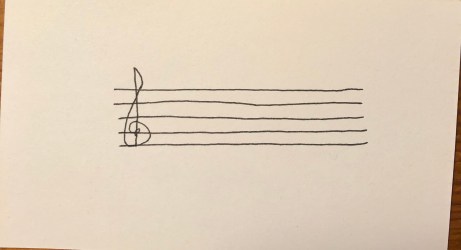
One summer I was reading Michael Nyman’s “experimental music” about the sound/music/art movement under that name, works composed primarily in the ’50’s and ’60’s. In one discussion about the music of La Monte Young there was an image at the bottom of the page of one of his compositions. It was a treble staff, with two whole notes, a B and an F#, both with tie markings indicating the notes should be held. The two notes were not connected to any other notes, the tie markings simply extended to the end of the staff. I looked up several music publishing websites to see of I could buy a copy of the work, if it had ever been “published.” Couldn’t find any, so I photocopied the page, cut out just the music score, and enlarged it to fit an 81/2 by 11. It is truly remarkable how the physical size of a work can give it a kind of authority it simply doesn’t possess in a book. A marking below the staff in ( I assume) Mr. Young’s handwriting gave the direction “to be held for a long time.”
Enrolled in my “experimental” music class were a few instrumentalists ( snare, cello, trumpet and saxophone), none of the rockers ( guitarists can be shockingly conservative) and the rest of the fifteen students were singers. I thought the Young piece would be perfect.
The instrumentalists were outraged! There was no time signature! Is the piece in the key of C or G or b minor? There is no final bar! The staff simply continues! And the tie markings— they don’t tie to another note!! No dynamic markings!! What instrument is this for?? Which was kind of sweet really, because they were showing me how much they had learned in their years of music study.
The singers weren’t quite so outraged, actually didn’t say much at all, but as the instrumentalists were mostly boys, and the singers just about all girls… well, high schoolers.
When I was working toward an MA at Wesleyan I’d spoken with the world-renowned composer Alvin Lucier concerning a choral work that I was struggling to compose and he told me about a conversation he’d had with Morton Feldman. Professor Lucier’s first area of expertise had been in choral conducting. He told me Mr. Feldman wanted to know, not what the extreme ranges for singers were, but rather, what were the ranges in which they were most comfortable singing. It was a very interesting compositional strategy— write what is well-within the comfort zone.
So when I thought about the notes Mr. Young had chosen, it made a certain sense. The B below Middle C, and the F# above— not too high, not too low. A little brighter than, say, Bb and F, which perhaps, having been held for a long time, might tend toward flatness, but not so plain as a C and G, which, somehow would have seemed, I don’t know, insincere? Whatever your conclusions, it’s a forthright, sturdy perfect fifth.
I asked the group to stand in a circle, so that everyone could hear everyone else. I asked that each pick one of the two notes. That wasn’t going to happen! I seem to remember one of the boys working it out with one of the girls just who would sing which note. And I get it, when asked “do you feel like singing the B or the F#?” I’m not sure I’d have a ready answer either.
Then I said, let’s hold these notes for as long as we can. There are enough of us so that when you run out of breath, simply relax and take another breath to continue. That wasn’t going to work. “Mr. Rose, we can’t do this for, like, forever.” True.
So we decided on two minutes.
They sang the notes, on an “oo”. That proved it was possible. Then we sang for five minutes on an “ah.” Finally, with little or no encouragement on my part, they sang it one more time on either an “oo” or an “ah” for– ten minutes!
And, well, they realized what was happening— the sound kept changing! All the time! Cool! Some even wanted to sing it for twenty minutes, but by that time class had ended.
In summing up the day’s experience for the students I added, “Next week, I’m going to bring another piece for you to perform, I think you’ll find it quite remarkable, you will all be able to readily perform it, and it is exactly four minutes and thirty-three seconds long!”
****
As a postscript, I would suggest that the La Monte Young piece, titled “Composition 1960 #7” is a fitting bookend to the John Cage 4’33”. Both works are a study in music-making. Cage includes the universe; Young examines sub-atomic particles.

 HinjNoiz