
“Landon Rose flies a kite attached to the strings of his Fender Telecaster guitar —- music during ‘The Electro Acoustic Kite Performance’ on Saturday May 16, at Larz Anderson Park. Rose and fellow musician Neil Leonard explored the possibilities of interfacing kites with musical instruments during the event.” –Brookline Tab May 21, 1998

My son loved flying stunt kites. We owned a number of them and a few single line kites, too. Around the time of this performance I was trying to get work as an artist-in-residence, doing sound workshops with fourth and fifth graders in the public schools.
In the picture above the kite string is looped into the E string on the guitar. I believe that’s what I did. As it pulled on the string the pitch glissando’d up or down depending. Other than that, it didn’t really do much. I had hoped that there would be something in the vibration of the string that might translate but the connection of the string to the wire dampened it. In hindsight, using a Strat with whammy bar springs was the way to go, but at the time I was hesitant to expose mine to such conditions.
I also used a stunt kite with 10k ohm flexible resisters ( purchased from Digi-Key)
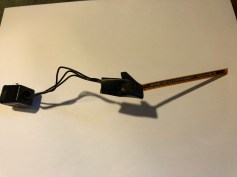
that output voltage (5volt) changes to a MIDI converter kit (1/4Watt –not surface mount) I built, purchased ( online in 1997) from a company called PAVO.
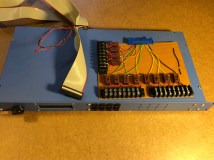
I had been learning a sound synthesis program called SuperCollider, version 2.x. In that version the sound synthesis engine and the unit generator graph operated, how to say this correctly, as a single program. I was running it on a PowerBook 2400. The values were sent to the laptop via MIDI cable into SC in which I had written some basic LFO/Sine/Delay configurations.
I also attached tin cans to kite strings and amplified those sounds through a sound system.
So, when it was all running, there was the sound of single string kites vibrating in a tin can, the guitar string glissing up and down ( less than an octave ) with the stunt kite sending MIDI info via the flexible resistor strips held in each hand.
The sound system was a Biamp 40watt and a Bose 800 speaker system. I rented a 40amp Honda power generator to run everything.
Neil Leonard, the composer, was my collaborator. He had purchased a sensor kit which input to a laptop which was running MAX, which at that time was only running MIDI with no sound generating capability. I am not sure what he did with a kite, but I do remember that MAX crashed early on, as it was wont to do in those days.
SuperCollider’s pull for me was its text-based programming style and that it produced its own sound. My understanding of programming was extremely limited so I couldn’t really do much with it. That said, it never crashed on me, because I never attempted anything all that complicated.
We received funding from a composer’s granting agency and perhaps from the Brookline Arts Council. Neil was teaching at Berklee at the time so that helped.
I would say between 30 and 50 people came by at some point during the ‘performance.’ The word implies continuity or planning or beginning/middle/end, which the event simply didn’t have. For a couple of hours we did everything we could do to make sounds with the kites and the electronics we brought, then we stopped. I doubt if anyone was fulfilled or moved, most likely disappointed, in the sense of experiencing a thought-provoking movement of sound through time.
I wanted to be able to input the trajectory of the kites in the sky, their movement, but at that time the closest commercial GPS information I could retrieve was +- 50 feet, not very useful. I was told the military quantization level was much more precise.
The picture above is fantastic. The photo is by Jennifer Taylor, I assume a Brookline Tab photographer.
One friend did come up to me and said “You’re experiencing that state of grace.” I suppose he was right, but I think the point was for him to experience the grace! I was too preoccupied with getting things to run.

 HinjNoiz